
North Chicago Previous Residents by Era
The best starting source depends on the date. Lake County land records can establish ownership, while a directory or census can place a household at the site. Modern street numbers should not be forced onto an early parcel. For the oldest North Chicago trail, use the legal description, block and lot, maps, and the source's own place name.
| Source | Period Covered | Where Kept | What It Can Show |
|---|---|---|---|
| Land books and deed indexes | 1841 to present | Lake County Clerk, IRAD, PublicSearch | Transfers, parties, dates, legal descriptions |
| Atlas, maps, and census | 1880 to 1959 | LCGS, WPL, census collections | Early blocks, households, ward and map clues |
| Polk/Harris directories | 1874 to current, with gaps | Waukegan Public Library | Dated names and addresses |
| Telephone books | 1930s to 1961 | WPL and Library of Congress | Adult names, phones, address snapshots |
| Parcel, GIS, permits, FOIA | Current systems | Lake County and North Chicago | PIN, map context, current files |
Start with deeds for ownership, then test the same date against household sources. WPL's runs include 1892 to 1901, 1903 to 1904, 1908 to 1909, several later groups, and 1959 to current holdings. These are shelf holdings, not a promise that each North Chicago name appears in every volume.
Pin Down a North Chicago Parcel
A current PIN is safer than a street number alone. The Lake County real-property search accepts parcel ID, owner, billing name, or address. Save the returned PIN, situs address, municipality, township, and assessment-year label. Situs means the physical parcel location. A tax mailing address is a separate field and is not proof that a person lives there.
Compare that PIN with the Tax Parcel Viewer and newest recorded deed. If a parcel was split or combined, an old deed may carry a different PIN. A plat, certificate of error, easement, or prior legal description can explain the change. The modern parcel becomes a bridge to older books, not a claim that the number stayed fixed.
Note: Remove a unit or direction and try a suffix variant when an exact North Chicago address produces no result.
Follow Lake County's Deed Chain
The Lake County PublicSearch advanced index supports party, PIN, property address, book and page, subdivision, legal description, and historical-record searches. The current index reaches from 1980 forward. Earlier work uses Historical Record, Online Index Books, the Waukegan public terminal, or IRAD. County staff can help at the terminal, but the office does not perform a title search.
- Pull the current PIN and legal description from the assessor and newest deed.
- Record the newest deed's document number, date, parties, PIN, and image status.
- Search the seller as a grantee to locate that party's earlier purchase.
- Repeat one transfer at a time and note probate, plats, releases, and name variants.
- At the 1980 boundary, move to historical books, the county counter, or IRAD.
- Grantor and grantee
- The grantor transfers an interest; the grantee receives it.
- Chain of title
- The linked sequence of recorded transfers for one parcel.
- Legal description
- The formal land description that can survive a street-name or number change.
Copy routes include the online system, mail, fax, phone, email, and the public counter at 18 N County Street, 6th Floor, Waukegan. The research lists copies at $1 per page. Cite an index row as an index if the deed image was not viewed.
North Chicago Deed Search Screens
The advanced land-record search shows the fields that reconnect a current address to an older legal description.
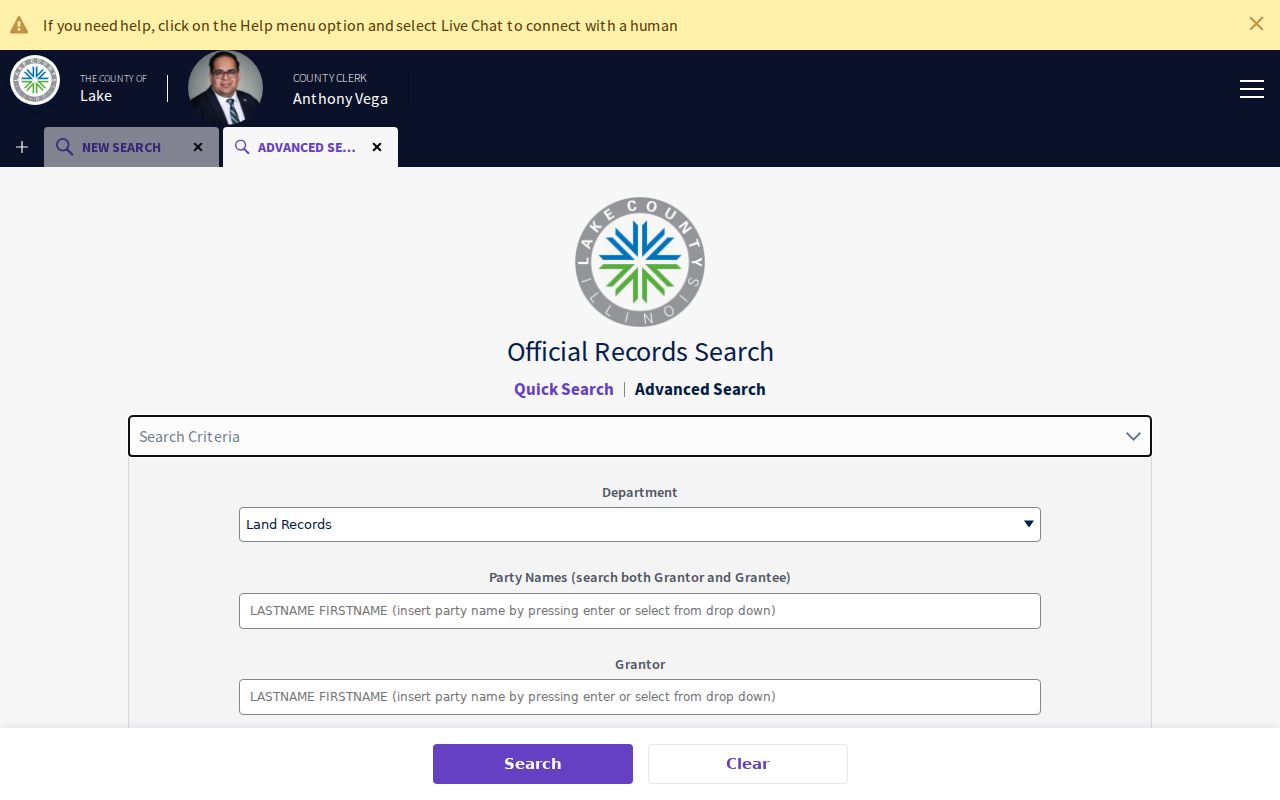
Party mode, dates, PIN, address, book and page, and legal-description fields support a careful backward search. The document-type list loads dynamically, so no full list should be assumed.
The county's Property Alert page is another captured source tied to recorded documents.
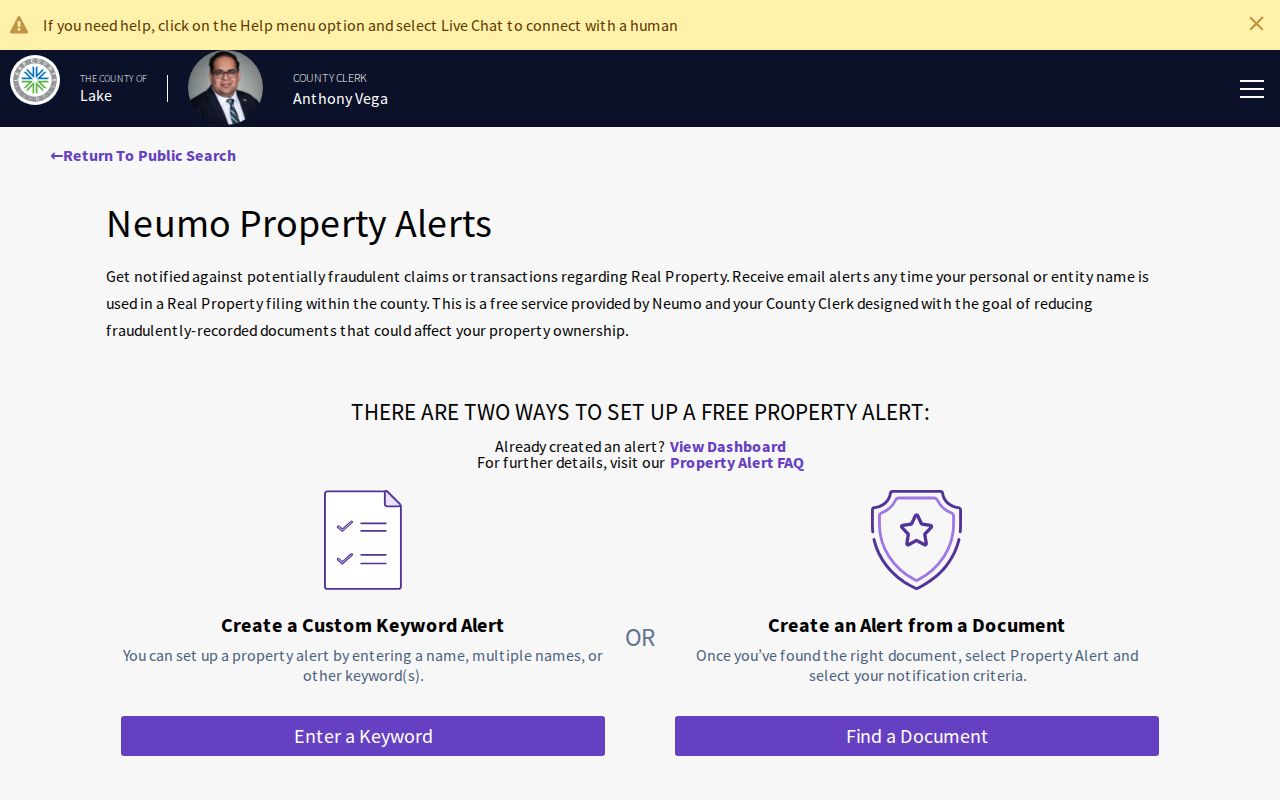
Property Alert is a notice aid, not proof of ownership and not title insurance. Confirm any alert against the recorded item and parcel chain.
Build a North Chicago House File
The City of Waukegan's house-history guide applies well to North Chicago because county-seat repositories cover both places. It suggests asking when the building was made, who built it, what it looked like, who owned it, what it cost, and how the area changed. Its sources include deeds, tax files, maps, directories, census, wills, phone books, Sanborn maps, news, photos, and landmark files.
Create one row per date. Keep owner, occupant, street label, PIN or block and lot, source title, page, and what the item proves. This stops a deed party from being mislabeled as a resident. It also shows where the evidence switches from a legal parcel to a household snapshot.
Maps Rebuild Old North Chicago Addresses
Sanborn fire-insurance maps, mostly from the 1870s through the 1950s in the local guide, can show street numbers, building footprints, material, outbuildings, and utility clues. Work backward from the newest sheet. Match a map to a deed's legal description or a stable cross street before attaching a household name.
The Lake County Genealogical Society adds an 1885 atlas index and 1861 and 1873 maps. Its census holdings span several years from 1840 through 1930. These help when an early block lacks its modern form. No official North Chicago renumbering schedule was found, so a number change stays unresolved until maps, plats, directories, or ordinances connect it.
North Chicago's Older Place Names
Past residents may be indexed under South Waukegan, North Chicago, Waukegan, Great Lakes, a township, ward, or postal label. The Encyclopedia of Chicago says village incorporation came in 1895 and South Waukegan remained the name until 1901. The city's 2024 Comprehensive Plan gives 1891 as city incorporation. The sources conflict, so preserve both and search both names.
Great Lakes adds another layer. A military source may use the installation name while a parcel source uses North Chicago. Waukegan is also the county seat and repository address. A Waukegan directory or newspaper can contain a North Chicago event, but street, ward, municipality, and parcel still need checking.
Preservation clue. Lake County history says records survived the 1875 courthouse fire, so early books and IRAD holdings remain worth checking.
Pair North Chicago Directories and Census
Deeds name transfer parties. They do not list all previous residents. Polk/Harris volumes, telephone books, census schedules, and street sections can place a household at an address on a dated snapshot. The shelf runs and entry method appear in the North Chicago directory book.
- Choose the directory closest to the target year and copy entry, page, and printed place.
- Check the street section or phone book for the address and nearby numbers.
- Pair the entry with the closest public census schedule and its original geography.
- Search newspapers, probate, funeral files, and obituaries when a name vanishes or a deed shows an estate.
WPL provides directories, maps, news, and in-library genealogy tools. Waukegan Historical Society holds directories, ledgers, yearbooks, photos, and person or place files, with an appointment advised. LCGS adds probate, death, marriage, funeral, and map leads. IRAD at NIU is the fallback for original county and city series by date.
Limits on North Chicago Previous Residents
A deed party may never have occupied the building. A directory reflects its publication date, and the library run has gaps. Census geography may not match today's ward. PublicSearch and old index books require different methods. A sound conclusion states record type, date, label, and evidence level.
Use the trail for family history, house research, estate work, and personal curiosity. Keep tax-mailing details out of notes, and do not reconstruct a protected address. Illinois Address Confidentiality Program records may use a substitute address, while sealed or restricted files remain outside a public search.
Lawful use. Never use a North Chicago previous-resident trail to watch, threaten, harass, or harm a living person.